ADDRESSING SAFETY TO INCREASE RIDERSHIP

for Chicago Transit Authority (mock project)

PROJECT OVERVIEW

The Chicago Transit Authority (CTA) is the second biggest public transportation system in the United States. In a city of 2.7 million people, about 1.6 million riders rely on its service on an average weekday. The CTA experiences a range of issues—delays, interruptions, and closures that cause a negative impact for riders. Over the years, there has been a decline in ridership and an increase in car traffic in the city of Chicago. For this mock project, my team was tasked to create a digital solution to increase ridership and confidence in the CTA rider community. Our final product had to leverage Google Maps’ API, a mapping platform that provides data of track location, distance, direction, and current traffic conditions
CLIENT: DESIGNATION
SERVICES: UX, UI
Team: AMY COWIN, STEVE TSUKINARI
TIMEFRAME: 4 WEEKS

Glad you're here but this project is a throwback.

This is an older case study, and my skills have leveled up since then. Head over to My Work for my recent stuff.

MY ROLE

I worked within a team of three UX designers in four-week sprints: (1) User Research, (2) Concept Development and Testing (3) Reiteration, Testing, and Final Deliverable. Although the responsibilities were shared throughout the process, each designer created conducted interviews, created wireframes, and led user testing.

This was a mock project to help the UX designers utilize the UCD design process. Outside the mock project, I took the initiative to create the UI for our final design to showcase my visual design abilities.

CHALLENGE

CTA riders need to feel more in control of their safety during their commute, so they could utilize the CTA regardless of the time or environment.

Our research validated that there was a decline in overall ridership. However, we learned that rail ridership stayed pretty stagnant over the years, and delays didn’t attribute to the decline significantly. The problem we saw was that there was a decrease in rides per rider.

As we look further into this decrease, our research presented that safety affected rider’s commuting experience. Nearly all riders had experience risky situations on the CTA. Past experiences led riders to opt for rideshare or to choose not to travel during times when they feel unsafe. Some riders felt powerless when witnessing disruptive behaviors on the CTA.

SOLUTION

As a result of research and numerous rounds of iteration, my team converged to our final solution that focus on addressing safety with a transit app.

Chi Line helps riders avoid undesirable situations during their commute by creating alternative routes with other riders’ submitted safety reports. Keep the CTA safe for everyone.

Mobile screen of CHI Line app showing emergency call option, a prompt to report CTA disruptions, and buttons for creating a new report or checking report status.
Young man smiling and wearing a light gray polo shirt in a bright indoor setting with blurred people in the background.

Sam sends a safety report during his commute.

Sam is using the Red Line to run errands. During his commute he notices that there’s an intoxicated rider causing commotion. Sam decides to report this rider.
Smiling young man with short hair wearing a light gray collared shirt in an office setting.

Sam sends a safety report during his commute.

Sam is using the Red Line to run errands. During his commute he notices that there’s an intoxicated rider causing commotion. Sam decides to report this rider.
Mobile app screen with CHI Line emergency note, buttons to create new report or check report status, and navigation icons at the bottom for CTA Route, Report, Home, Send ETA, and Community.
Smiling woman with long dark hair looking to the side outdoors with blurred background.

Jackie takes safer route to her destination.

Jackie is meeting some friends at restaurant after work. She was planning on taking the fastest route but decides to take an alternative route instead due to a safety alert.

UI DESIGN WORK

As a result of research and numerous rounds of iteration, my team converged to our final solution that focus on addressing safety with a transit app:
Still interested? 
Scroll down to see the extended version of the case study
Extended version is available for desktop and tablet viewing.

01 // DOMAIN RESEARCH

THE BRIEF

Chicago Transit Authority (CTA) made gradual improvements with their digital product. But there was a declining trend in CTA ridership.

Current offering allowed for individual alerts, per transit line or location but wasn’t responsive enough to increase customer satisfaction. Riders needed a product that had a holistic understanding of riders specific route. Although delays and interruptions were inevitable, they needed transparency for the specific outage affecting their commute. My team included of CTA and Metra commuters who had exposure to these interruptions and delays—this hit home for us.

In response to the brief, my team had the following initial assumptions based on what we know as CTA and Metra commuters:
Assumption 01
CTA riders don’t plan their commute ahead of time if they were taking a daily route.
Assumption 02
CTA riders prefered one CTA transportation method over another for various reasons such as cost, convenience, and comfort.
Assumption 03
CTA riders used varying methods to overcome transportation-related interruptions when they encountered one during their commute.
Assumption 04
CTA riders relied more on ridesharing services such as Lyft, Uber, and Divvy as another means of transportation.

COMpetitive analysis

We found that the public transit space was saturated with apps and services.

To further familiarize ourselves with the transit space, we looked at what digital resources CTA riders utilized in their daily commute. We identified our top three competitors to be GoogleMapsTransit, and Moovit. These competitors offered navigation information for many modes of transportation—public transportation, ridesharing, walking, and biking. Also, they provided information of current delays and interruptions. Also, most services even provided alternative route options during these delays and interruptions.
Public transit directions from Merchandise Mart to Little Goat Diner showing the fastest route via Green Line subway taking 14 minutes, and alternative routes via Brown and Pink Lines taking 15 minutes, and Blue Line taking 19 minutes.
Transit app screen showing a map with location near Seward Park and three transit options: bus 70 west to Austin in 11 minutes, Uber cab arriving in 2 minutes, and bus 22 north to Howard in 1 minute; also a red line train at 95th/Dan Ryan arriving now.
Mobile app screen showing suggested public transit routes and walking route from current location to 222 West Merchandise Mart Plaza with times and transit icons.
Public transit directions from Merchandise Mart to Little Goat Diner with options for Green Line, Brown Line to Pink Line, and Blue Line trains showing travel times around 14 to 19 minutes.
GoogleMaps
[+] The app provided a comprehensive details of travel options with real-time traffic condition. Commuters can plan their travel and easily compare their travel options.
[-] The app did not display all the possible route options. Also, the real-time status wasn’t accurate as other dedicated transit apps.
Transit app screen showing map with location near Seward Park and bus/train arrival times for routes 70, 22, 95th/Dan Ryan, and Uber cab arrival.
Transit
[+] The app had a minimal approach to their transit experience. The public transit app displayed real-time status of nearby transit and route navigation for public transit and ride services.
[-] The app provided service status details, but did not provide alternate route options in response to these notifications.
Transit app showing suggested routes from current location to 222 West Merchandise Mart Plaza with options including bus, train, and walking routes and estimated travel times.
Moovit
[+] A public transit app that not only provide the best route with real-time arrivals, the app allowed users to personalize their app experience. Users could add specific routes to their “favorite.”

[+/-] Also this app’s service alert was through CTA twitter feed, which was interesting, but did not provide an actionable outcome.
[-] The app did not have a filtering option for transit if users had a traveling preference.

INITIAL RESEARCH

We utilized the CTA 2016 Annual Ridership Report, to further familiarize ourselves with the project brief. We investigated the following changes that had a potential impact on the ridership figure. 
Icon of a gas pump inside a circular border.
Low gas prices and ridesharing contributed to decline in ridership.

Low gas price encouraged some riders to opt for driving personal vehicles and using rideshare services. This increased competition in the public transit space.
Light blue icon of a train facing forward inside a circular border.
There were more rail service impacts in 2016 than in 2015.

Service impacts consisted of track work, signal problems, and station closures. Temporary closures were seen on some Green, Blue, and Pink stations.
Icon of a person digging with a shovel inside a circular border.
Heavy road construction affected the system-wide transportation service.  

Downtown constructions contributed to the bus delay—this forced commuters to use alternative traveling options.

VALIDATING THE BRIEF

Rail ridership figures stayed pretty stagnant, but there was a decrease in rides per rider—meaning riders are riding the CTA less frequently.

Our initial research presented us an opportunity to challenge the brief a little further. Our brief posed the problem that delays and interruptions contributed to the decrease in CTA ridership. We validated the decrease in total ridership with the CTA 2016 Annual Ridership Report. However, the data showed that delays and interruptions had a small contribution to rail ridership with 0.7% decrease YOY.

We utilized the RTA Strategic Plan Progress Report to understand the decrease in rail ridership further. Regardless of the decrease in overall ridership, the Regional Transit Authority (RTA) saw an upward trend in rail ridership. But we uncovered an interesting data point—since 2012, there was a downward trend of transit trips per resident. If rail ridership was pretty stagnant, why are riders riding the CTA less frequently over the years?
Table showing year 2016 and 2015 public transit ridership in millions and delay statistics with year-to-year percentage changes, including total ridership 497.7m in 2016 down 3.5%, rail ridership 238.8m down 1.2%, and bus ridership 259.1m down 5.5%.
As we looked closer at the 3.5% decrease in the CTA 2016 Annual Ridership Report, bus ridership attributed most of the ridership decrease with a 5.5% decrease year to year (YOY)  while data suggested rail delay had a slight 1.2% decrease which was not impactful.
Line graph comparing world's largest banks by assets for 2023 in USD trillion, highlighting 11 US banks and ranking JPMorgan Chase first.
The RTA Strategic Plan Progress Report revealed that the Regional Transit Authority (RTA) saw an upward trend in rail ridership. However, transits trips per resident has been trending downward since 2012.

02 // SYNTHESIS

USER INSIGHTS

We conducted guerilla-style user interviews to identify the goals, needs, motivations, and frustrations of CTA riders. These participants were voluntary-based and recruited based on networks found through social affiliations. To make sure we get a well-rounded perspective of commuters, we interviewed a diverse group of users and subject matter experts. From our affinity mapping, we uncovered a few insights from our user interviews:
INSIGHT 01 //
No clear communication among CTA personnel
According to our SME, CTA employees had four communication methods to notifying delays or interruptions, but no set standard. This helped us understanding the application space. If CTA personnel didn’t have a notification method i place, why would the public?
"The communication isn’t always smooth."
—"Uncle Bob"
(CTA Customer Service)
Extended version is available for desktop and tablet viewing.
INSIGHT 02 //
Users address commuting issues on the spot
CTA riders didn’t check for delays before their commute. They addressed this issue when they encountered it, but their method for dealing with it varied from user to user.
“You just deal with it when you get there.”
—Peter
(Engineer, 30)
Extended version is available for desktop and tablet viewing.
INSIGHT 03 //
Ridesharing service provided convenience and comfort
Users acknowledged that ridersharing services was costly than public transit when used frequently. They opted for rideshare when they looked to save time or a public transit wasn’t nearby their destination.
“I takes a Uber in the early morning because it gets me to work faster; plus it's comfortable.”
—Susie
(Guest Service Agent, 63)
Extended version is available for desktop and tablet viewing.

Glass wall covered with numerous colorful sticky notes arranged in clusters for brainstorming or project planning.

insight revisit = PROJECT PIVOT

Safety was an important factor in riders’ commuting experience.

After revisiting our affinity mapping and domain research, we saw our synthesis pointing away from riders’ interruptions. Delays, slowdowns, and cancellations had negative impacts to riders’ commuting experience, but data showed that these interruptions had small contributions to CTA ridership.

As we connected the dots, my team saw safety as one of the contributing factors for the decrease in rides per rider. Safety is a priority for city commuters and influence how riders move around the city. Based on our insights from research, the following points supported why safety was an important pain point for our users:
TAKEAWAY 01 //
No transit safety app in the mobile marketplace.
The digital space for transit apps appeared crowded and too similar. The majority of the apps in the space addressed delays and slowdowns on the CTA. However, there were no transit apps that addressed safety to alleviate a rider’s CTA experience.
TAKEAWAY 02 //
Users saw no benefit in stopping unruly behavior, fearing their safety would be jeopardized
Many users shared their commuting experience as either: individuals feeling their safety was at risk or as a witness seeing another rider’s safety at risk. Users wanted to address disruptive behaviors but felt powerless due to the lack of personal incentive to take action.
TAKEAWAY 03 //
Users' expectations of their riding experience changes depending on the time of day.
We learned that some users opted to use a ridesharing service at night or changed their behavior to not commute at certain times. The fact that riders felt the need to position themselves to avoid the CTA was still an unspoken concern. We wanted to dig deeper into this.

THE PROBLEM

We articulated that safety was a common concern from users—this was a big pivot for our team and pointed us to our problem statement:

CTA riders need to feel more in control of their safety during their commute, so they could utilize the CTA regardless of the time or environment.

With our more focused problem, we outlined four design principles to ensure our design solutions aligned. Our design principles set the tone for ideation phase. We used them to guide our work and gauge every design decision during our concept ideation and iterations. Ultimately, these principles communicated the key characteristics of our product.
Icon of two stylized faces facing each other with sound waves between them on a yellow circular background, symbolizing communication.
Human Connection
Interaction with the app should be conversational, building trust through dialogue. The experience should reassure users that they were making a positive impact by reporting incidents.
Black speech bubble with a heart symbol inside on yellow circular background.
Sensitive Approach
Disruption in the CTA should not be taken lightly. The language should be sensitive and courteous to the events taken place and commuters involved.
Icon of a hand with an extended index finger touching or clicking, with lines radiating to indicate a tap or click action on a yellow circular background.
Actionable Participation
The app should provide an actionable plan for a user when encountering a commuting disruption.
White thumbs-up icon inside a blue circular background.
Discrete Confidence
The app should allow users to feel confident in sharing their safety concerns. Reports were anonymous through a private channel to keep our users safe.

03 // OUR USERS

USER PERSONA

Based on our set of interviews, Jackie and Sam highlighted the two subgroups of rail riders. The two personas have distinct needs and approach to safety. We utilized Jackie and Sam to understand who we were designing for:
Smiling woman with long dark hair outdoors, accompanied by text quote about assessing risk as a woman.

Pragmatic workday commuter

Age: 31 / Location: Logan Square
Occupation: Content Manager / Status: Married
As a pragmatic workday commuter, Jackie often left work late in the evening. She needed to feel safe enough to take public transit instead of opting for an expensive ride share.
Smiling young man in a light gray shirt with a quote above saying, "It's always a gamble what you get on the CTA."

Ambitious College Commuter

Age: 20 / Location: Lincoln Park
Occupation: Student / Status: Single
Sam enjoyed the accessibility and convenience of the CTA, but hated observing disruptive behavior on the train. As an ambitious college commuter, Sam needed accessible resources to empower him in making a positive difference to his surroundings.

JOURNEY MAP

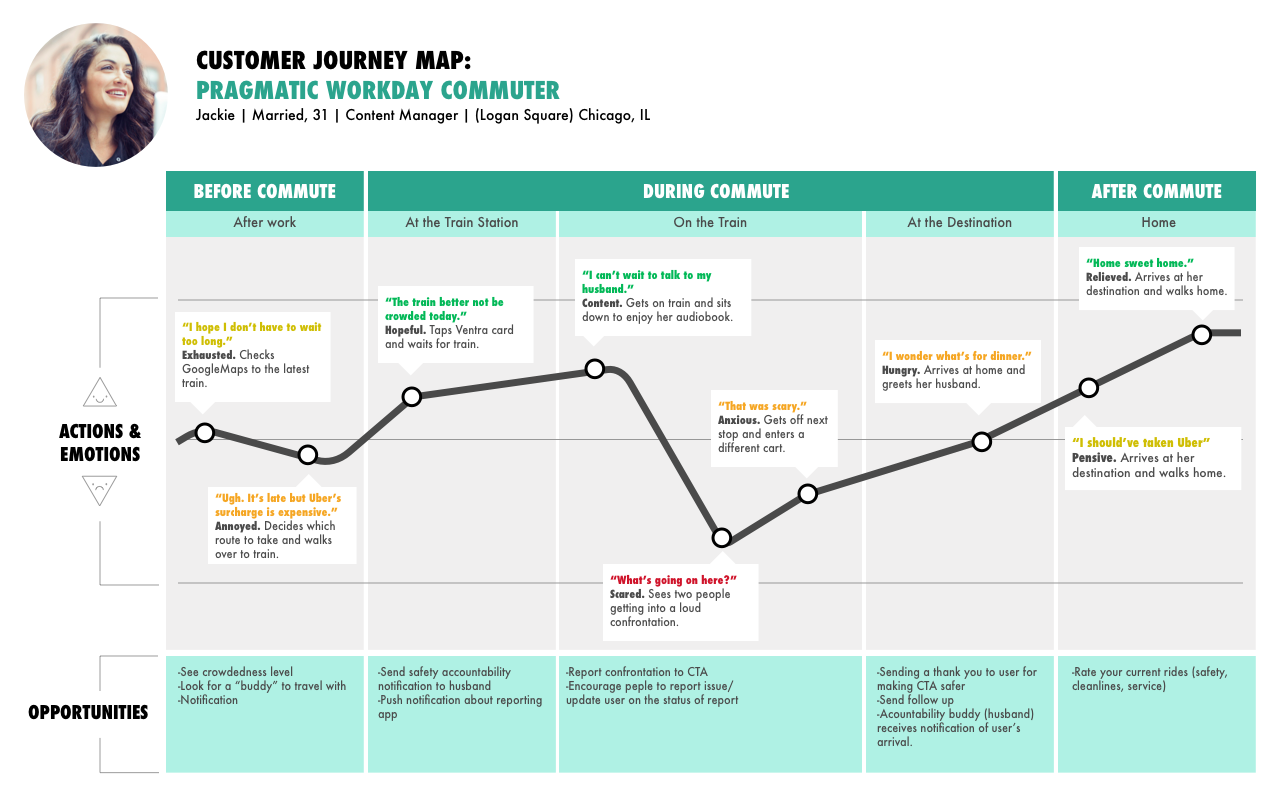
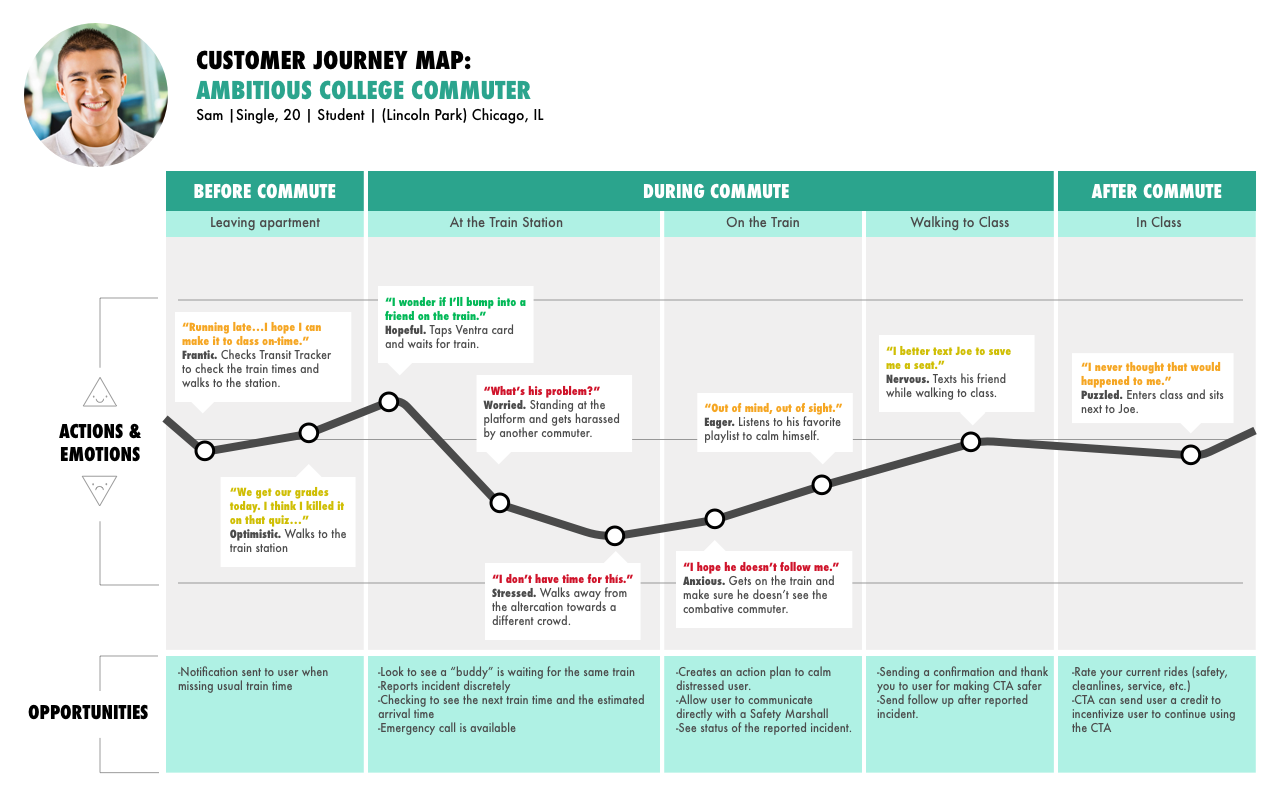
As we moved towards the ideation phase, journey mapping helped us better understand our users like Jackie and Sam. As we walked through their commuting experiences, we fleshed out the thoughts and emotions of our users when encountered with a risky situation during their commute. Although the journey map helped us pinpoint the highs and lows of their journey, it also defined opportunities where our team can better design for our users like Jackie and Sam.

The walkthrough uncovered these opportunities:
  • Provide a better way for riders to receive support and accountability for their commute.
  • Empower user to send safety reports to keep the CTA safe.
  • Utilize the follow-up notification to express gratitude for user’s report submission.
  • Communicate the benefit of keeping the CTA safe for the riding community.

04 // CONCEPT + TESTING + REITERATION

IDEATION

Whiteboard filled with colorful sticky notes and handwritten brainstorming notes about app concepts, user motivation, chatbots, community features, and action plans.
Multiple sheets of paper with hand-drawn mobile app wireframe sketches laid out on a gray surface.
Our ideation session consisted of a combination of brainwriting and mind-mapping. We built off on the initial ideas through brainwriting and placed the potential concepts onto sticky notes on the whiteboard. The picture above displayed how messy our mind-mapping looked on the whiteboard. We wrote pros and cons of each sticky note ideas on the whiteboard to ensure our concept met the needs of our users. As we grouped the sticky notes, we pinpointed areas of focus to get us ready for several rounds of 6-8-5 sketches.
Three panels illustrating actions before, during, and after a commute with simple line drawings and labeled boxes describing safety actions like requesting a safe ride, reporting disturbances, and confirming arrival.

PAPER PROTOTYPE


We took the opportunity to go wide with our concepts and explored different approaches to addressing safety for users during their commute. We tested these concepts with six participants to ensure the concepts fit into their commuting experience. The general feedback was positive from users. Users felt empowered with these concepts but wondered if other users would be motivated to use the app.
Hand-drawn wireframe of an Elly app screen titled 'Report An Attack' with text boxes for details, location, and people involved, plus submit and back buttons.
Hand-drawn interface sketch for requesting a safe ride with fields to reserve a time, select a date, an unchecked recurring option, and a next button.
Hand-drawn app interface sketch showing Notify screen with user profile labeled Alex Baldwin Husband, options to Notify Me or Message Me, two selectable locations, and a large Send button, along with navigation icons at the bottom labeled Home, Station, Alerts, and Directions.
(Teammate concept)
Submit a report
Users submitted a safety report of a disturbance during their commute. 
(Teammate concept)
Request a safe ride
A ticketing system where users can request a ride on a CTA cart with a safety marshall onboard. 
(My concept)
Send a ETA
Users notified a friend to track their real-time commute and their ETA.
VIEW MY PAPER PROTOTYPE

REITERATION + APP MAP

Flowchart showing reporting methods, supplemental features, and bottom navigation with options like Home/Navigation, Report, ETA Buddy, and Community Board, leading to functions such as Get Directions, Receive Alerts, Real-Time Tracker, Send Report, Check Status, Send ETA, ETA Buddies, All Board, and My Board.
Our initial testing validated that the problem we defined was more relevant than ever—report concept was a crucial feature to have on our app. My team felt that there was room to reiterate and diverge. We further explored different report methods and three supplemental concepts.

However, we knew that users wouldn’t download our app only for the safety report function. Moving towards a cohesive product was challenging as we converged to one solution. We didn't want the features to feel forced together. The features needed to integrated one another. The following questions challenged us to converge our ideas:

How do we motivate users to report?

Based on research and testing, users were intrinsically motivated to report disruptive behavior when their safety isn’t jeopardized.

However, reporting needed to provide an expected outcome that benefited the users.

What is the expected outcome after reporting?

The submitted safety reports created alternate routes for other commuters so that they can avoid undesirable situations.

MID-FIDELITY PROTOTYPE

To further iterate and test the feasibility of our concept, we jumped into mid-fidelity prototypes. We tested our prototypes on five CTA commuters who fitted closely to our personas. Participants were voluntary and recruited based on networks found through social affiliations. Each team member focused on a reporting method and a supplemental feature:
Reporting Methods
Mobile app screen titled CHI Line creating a new report with fields for location, car number, incident description, people involved, and contact permission, followed by a Next button.
Safety report form page asking to describe a disruptive commuter by selecting gender, hair color, approximate height and weight, and providing clothing or object details with a Next button below.
Virtual safety assistant chat interface for CHI Line by CTA offering report options: Inappropriate Behavior, Cleanliness Issue, Other Issue, Suspicious Item, Lost & Found.
(Teammate concept)
#1: One-page form
This method allowed users to fill out the safety report on one scrolling screen to increase efficiency.
(My concept)
#2: Multi-page form
This method breaks the safety report form into digestible sections.
(Teammate concept)
#3: Chatbot
This method created the most human connection between user and the app
Supplemental Features
Navigation screen for CHI Line showing route to Sun Wah BBQ with estimated time of 30 minutes and alert for unruly behavior on car 5050.
Mobile app screen showing user Alex Rivera with roommate status, options to select commute start Clark/Lake and add destination, and a Send ETA button.
CHI Line app screen showing Community tab with two user posts: one about a 30-minute delay on Brown Line, another warning about harassment on Red Line car 5667.
(Teammate concept)
#4: Navigation
The navigation feature gave users upcoming departure times like other transit apps.
(My concept)
#5: ETA Buddy
This concept provided users additional tool to take safety precaution and increase awareness among users.
(Teammate concept)
#6: Community Board
This concept allowed users to take part in a CTA rider community to increase user engagement.
From testing we learned: 
  • Conversational Tone // The voice and tone of the app should match who it was being designed for. Based on testing users liked the "human connection" in concept #3 and felt that concept #2 was more inutitve. For reporting, the order of questions needed to flow in a logical, natural way to reflect our users' mental models of recalling an episodic event.
  • Lacked clarity // Every screen should provide a clear purpose of what the task is at hand. As we converge to a solution, we needed to make sure to clearly communicate the upfront value of the app features.
VIEW AXURE PROTOTYPE

05 // FINAL DESIGN

Chi Line helps riders avoid undesirable situations during their commute by creating alternative routes with other riders’ submitted safety reports.

Keep the CTA safe for everyone.

01
Safety report
The app allowed users to report safety incidents that would notify other users.
02
CTA route
The app sent upcoming departure times of nearby lines and alternative routes based on notified safety reports.
03
Send ETA
The app allowed users to send ETA of their real-time commute.
04 
Community
The app provided a public forum where users could follow specific CTA topics.

06 // INDIVIDUAL CONCEPT + UI

MY PROTOTYPING PROCESS

As my team move towards prototyping, I utilized the design principles to guide my designs through my design reiterations.
Minimizing fear through sensitive approach
Our concept feedback revealed the importance of minimizing fear through the content. We wanted to avoid pervading fear in the CTA riding community with the listed report types.

I created a quick mind map, categorizing the types of report users would submit on our app. The CTA safety brochure instructed riders on how to report crime—this gave me a better idea of how to structure my report form.
Reflecting user’s mental model with human connection
The voice and tone of the report needed to match who it was being designed for. I wanted to approach the language in a conversational manner. For the supplemental concept, the language should reassure that sending an accountability notice will have a positive impact to their commuting experience. With the report, the flow needed to reflect our users’ mental models of recalling an episodic event. The order of questions needed to flow in a logical, natural way.
Making decisions through actionable participation
The overall experience of the prototype needed to motivate user to participate without feeling demanded to. I acknowledge that user might not utilize this app during every commute. However, it was important to ensure that the prototype provide the necessary tools to assist them when their safety is at risk. I wanted to create an experience that felt easy and highlighted the usefulness of these features.
Actionable outcome empowered by discrete confidence
We wanted to avoid encouraging vigilante action within the CTA community. With that in mind, we made sure that 911 emergency contact was visible throughout the report. This required us to rely on our riders to make their own judgment of the situation. We wanted to empower our users to take action with the given options.

VISUAL COMPETITIVE ANALYSIS

Outside of my time at DESIGNATION, I decided to revisit this project to create the visual design for the app. Before jumping into concepting, I analyzed the existing transit apps like _______. I found many competitors ________. Most competitors felt _______. Also I looked at some safety apps outside the transit app landscape to find ideas and inspiration to better inform my design exploration.

I further established a contemporary and clean style guide, logo, and icon suite. I choose colors that were bright so that they would work well as call outs in the interface design.

We found many competitors incorrectly balanced visual themes between the music and health industries, making them feel untrustworthy. Most competitors felt surprisingly outdated due to text-heavy pages, poor hierarchy, and stock photography—this excited me about potential differentiation for our client! To seek style inspiration and direction for our designs, we also examined many out of category products. Airbnb, Awair, Moodnotes, and Spotify were most inspirational to my design process.
Flowchart depicting reporting methods and supplemental features including navigation, ETA buddy, and community board, with a bottoms navigation bar showing Home/Navigation, Report, ETA Buddy, and Community Board, and their respective sub-functions.

STYLE TILES

I explored two style directions that differed in visual treatments and UI approaches.

06 // CONSIDERATIONS + REFLECTIONS

FINAL FEEDBACK AND CONSIDERATIONS

The final solution was created on Axure and was well received by our participants. However, more iterations were necessary.

These future considerations would improve the app experience for our users. With further testing and design reiterations, it would only help us get closer to our solution and validate that our solution solved our users’ needs. Although we presented a final solution to our cohort, our solution needed refinements. I don’t believe we solved our problem on our first try of concept testing, but we were headed in the right direction. I would propose my team to continue exploring these following areas:
Explore community forum further.
Majority of users responded positively to the community forum. They enjoyed the idea of being part of a CTA riding community, receiving up-to-date news about the CTA rail.

We added this feature later in the ideation process. The idea wasn’t completely fleshed out due to the lack of time. I would explore additional customization features. I envision the feature surfacing the most relevant posts to a user based on their route—this would allow for a better-personalized experience.
Further testing of "Sending ETA" feature.
We received mixed feedback on the sending ETA feature. Some users saw the benefit of the feature—it would eliminate users sending constant updates through text.

There was room for improvements and iteration on this concept. I would further test the value of this feature with users—how likely would they use this feature if it existed?
Alerts and notification integration outside the app
I acknowledged that our users would less likely use this app on a daily basis, but the app needed to fit in their lifestyle intuitively.

Push notifications and widgets could notify users of any events on the CTA outside the app. This could provide convenience for the user, and further exploration could be beneficial.
Displaying upfront value through onboarding.
Onboarding would explain what the app does and how the app benefits the user’s life.

I saw the onboarding as a chance to communicate the functionality of the safety report. The goal was not only to get the user set up but also convert users to “expert” user to make them comfortable with the app

FINAL THOUGHTS

Reflecting back on this project, I was glad that our team pivoted our focus on safety as a digital solution to improving CTA ridership. The objective of creating safer environment in a public space has focused mainly to accident preventions and crime-rate reduction. Personal safety urges the user to evaluate how comfortable or safe the user feels in any given situation. Personal safety is foremost a personal responsibility whether or not people make it a mindful priority. The issue of perceived risks is a barrier to many people’s use and enjoyment of the public space. By addressing personal safety, we presented a final solution that delivered an interesting user perspective and solved a much more relevant problem in an urban setting. 

As my first major UX design project, this project taught me to advocate for my users from the beginning to end. If we didn’t revisit and trust our research, we wouldn’t have found the “ah-ha” moment and delivered the design solution we delivered in the first place. The journey to our final outcome was not easy. Throughout this project my team experienced road bumps and turns. We were able to successfully embrace these challenges by being flexible with the design process. My objective as a designer is not only to create meaningful products, but also reiterate and refine my design thinking and process. This project helped me improve my design thinking by pushing my creativity in reacting to challenge very quickly. Please see how my design process has developed in my other case studies: Harbor Plan and Project Decibel.